Insights
The Quiet Battlefield: How Narratives Are Influencing U.S.–Venezuela Relations
U.S.–Venezuela tensions aren’t playing out in open conflict, but in the information space—where narratives shape legitimacy, resilience, and public perception. See how Argus tracks persistent messaging across platforms and reveals who drives it.

In 2025, relations between Washington and Caracas entered a period of renewed tension. Talks concerning electoral conditions and potential sanctions relief reached an impasse, after which the United States reinstated and expanded enforcement measures affecting Venezuelan oil exports and financial activity. Monitoring of shipping and transactions increased, and economic restrictions were applied more consistently.
Venezuela responded by scaling back cooperation in certain areas, including migrant repatriation, and issuing formal diplomatic objections. Officials in Caracas argued that the measures disrupted regional stability and contravened international norms. As the United States announced additional sanctions-related actions and increased maritime oversight in the Caribbean, interactions between the two governments became more reactive. By midyear, this pattern had solidified into a sustained exchange of measures that reinforced existing positions without escalating into direct confrontation.
That absence of direct military confrontation, however, did not signal de-escalation. Instead, competition migrated into less visible terrain. As economic coercion and maritime enforcement continued without decisive resolution, the information environment quietly became the primary battlefield. Here, influence mattered more than force, perception more than presence. Understanding narratives ceased to be an academic concern and became a practical necessity for anyone attempting to interpret information flows and cognitive maneuvering amid geopolitical tension.
When Perception Takes the Lead
Narratives are how conflict is experienced by distant audiences and domestic populations alike. They shape how events are interpreted, who is blamed, and which actors appear legitimate or sympathetic. In today’s information environment, facts rarely arrive on their own. They arrive wrapped in emotion, identity, and framing. The side that establishes the dominant narrative often secures an advantage long before formal diplomatic, economic, or military actions produce tangible effects.
In late December, that dynamic became visible. Between December 25 and December 29, 2025, Argus began to surface a recurring theme across Venezuelan social media: unity and resilience in the face of U.S. military activity in the region. It was not a single slogan or viral post, but a steady accumulation of messages—images of civilians going about daily life, officials interacting calmly with citizens, and commentators emphasizing national cohesion. Together, these micro narratives amassed nearly one million views across multiple platforms.
Using this example, Accrete’s Argus for Social Media Influence demonstrates the power of social media narratives.
Platform Ecology: How the Narrative Traveled
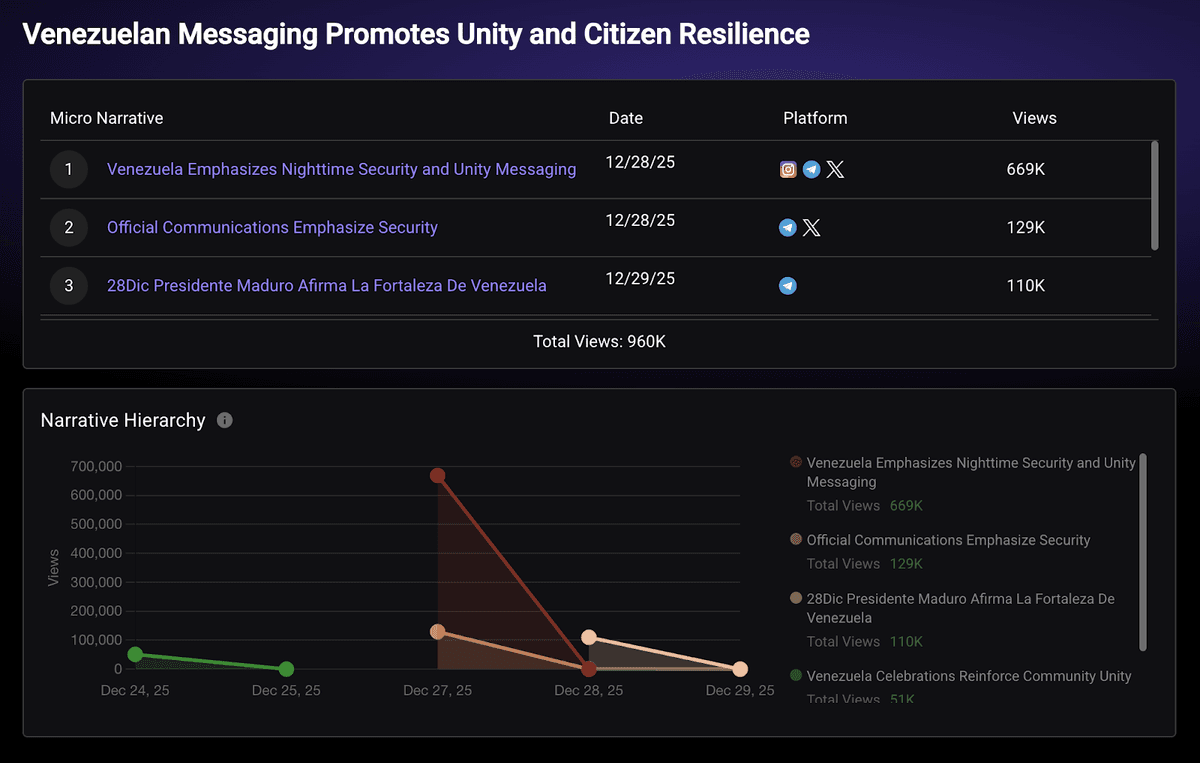
Viewed individually, the posts seemed ordinary. Viewed collectively, they told a story. Argus's narrative hierarchy analysis revealed that while individual talking points rose and fell, the underlying framing remained intact. The message did not spike and disappear with the news cycle. It persisted. That persistence mattered. Narratives that survive multiple cycles often signal normalization rather than reaction, creating evidence that an idea is being absorbed rather than merely asserted.
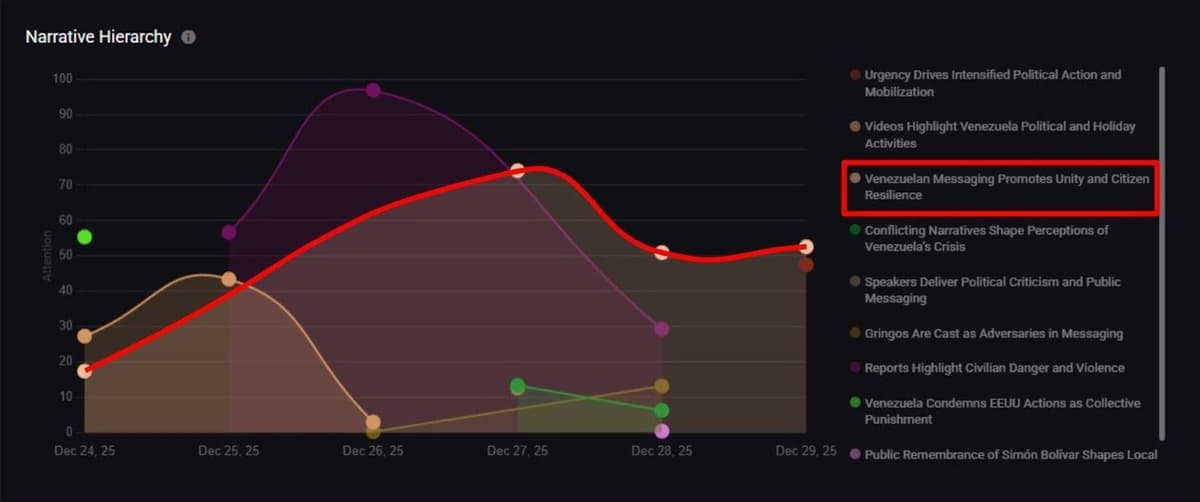
The story being told was clear: despite external pressure, Venezuela was holding together. This narrative was largely driven by state actors and state-aligned media, but it did not rely on heavy-handed propaganda. Instead, it blended official messaging with civilian amplification, creating the appearance of organic consensus. Hardship was acknowledged but framed as manageable. Security was emphasized without overt alarm. Unity became the moral center of the story.
This approach served several quiet but powerful functions. It reduced fear without denying reality, preventing panic or fatalism. It redirected frustration away from internal divisions, discouraging blame and dissent. It signaled to external audiences that pressure campaigns would not fracture society. Most importantly, it reinforced legitimacy without overtly demanding belief. The narrative did not insist—it endured.
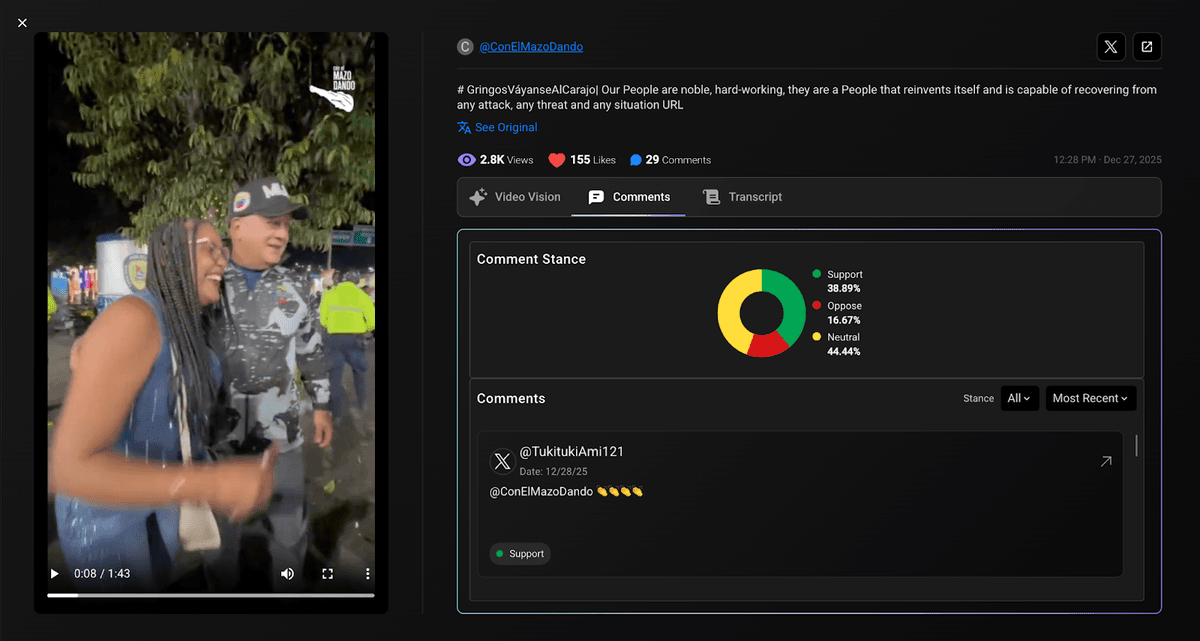
Behind this persistence was structure. Argus account analysis showed that the narrative was not sustained by volume, but by gravity. A small number of highly influential, state-affiliated accounts acted as anchors, setting the framing that others echoed. One example came from the X account of the state-run program @ConElMazoDando, which featured Venezuela’s Minister of Interior, Justice, and Peace, Diosdado Cabello, speaking with citizens in Caracas and highlighting public security. These posts did not argue. They modeled normalcy. Others followed.

The audience reaction reinforced the pattern. Stance analysis of comment sections revealed that most responses were neutral, with a significant share supportive and only limited opposition. This mattered more than raw sentiment. Neutral comments often functioned as amplifiers, extending reach without challenging framing. Supportive comments signaled social acceptance. Opposition existed, but it was fragmented, isolated, and lacked momentum.
By the end of the year, the implications were difficult to ignore. Economic pressure had intensified. Sanctions had multiplied. Maritime enforcement had expanded. Yet the dominant narrative remained intact. For planners and analysts, this distinction is critical. Surface-level dissent can coexist with deep narrative stability. A population that consistently frames hardship as survivable and unity as essential is psychologically oriented toward persistence rather than collapse.
Pressure, in this context, does not simply apply force. Pressure absorbed, interpreted, and reframed. Messaging designed to emphasize consequences may unintentionally strengthen endurance. Attempts to surface internal grievances may be rejected if they are perceived as threats to cohesion rather than acknowledgments of resilience.
The broader lesson is subtle but consequential. Calm does not equal neutrality. Resilience does not imply passivity. A narrative centered on unity and endurance is a signal that pressure is anticipated and accounted for. Recognizing that signal is not about agreement or alignment. It is about situational awareness. In modern geopolitical competition, the most powerful narratives are not the loudest. They are the ones that persist, quietly shaping how conflict is understood long before outcomes are decided.
- This content was created to demonstrate the use case for Argus for Social Media Influence and its capabilities. This is not a political statement or opinion piece.