Insights
Case Study: Autonomous Content Strategy with Knowledge Engines
How Accrete Used Its Own Knowledge Engine to Eliminate Content Bottlenecks and Produce Investor-Grade Messaging – from 7–10 Days of Iteration to 2 Hours of Grounded, Autonomous Synthesis.
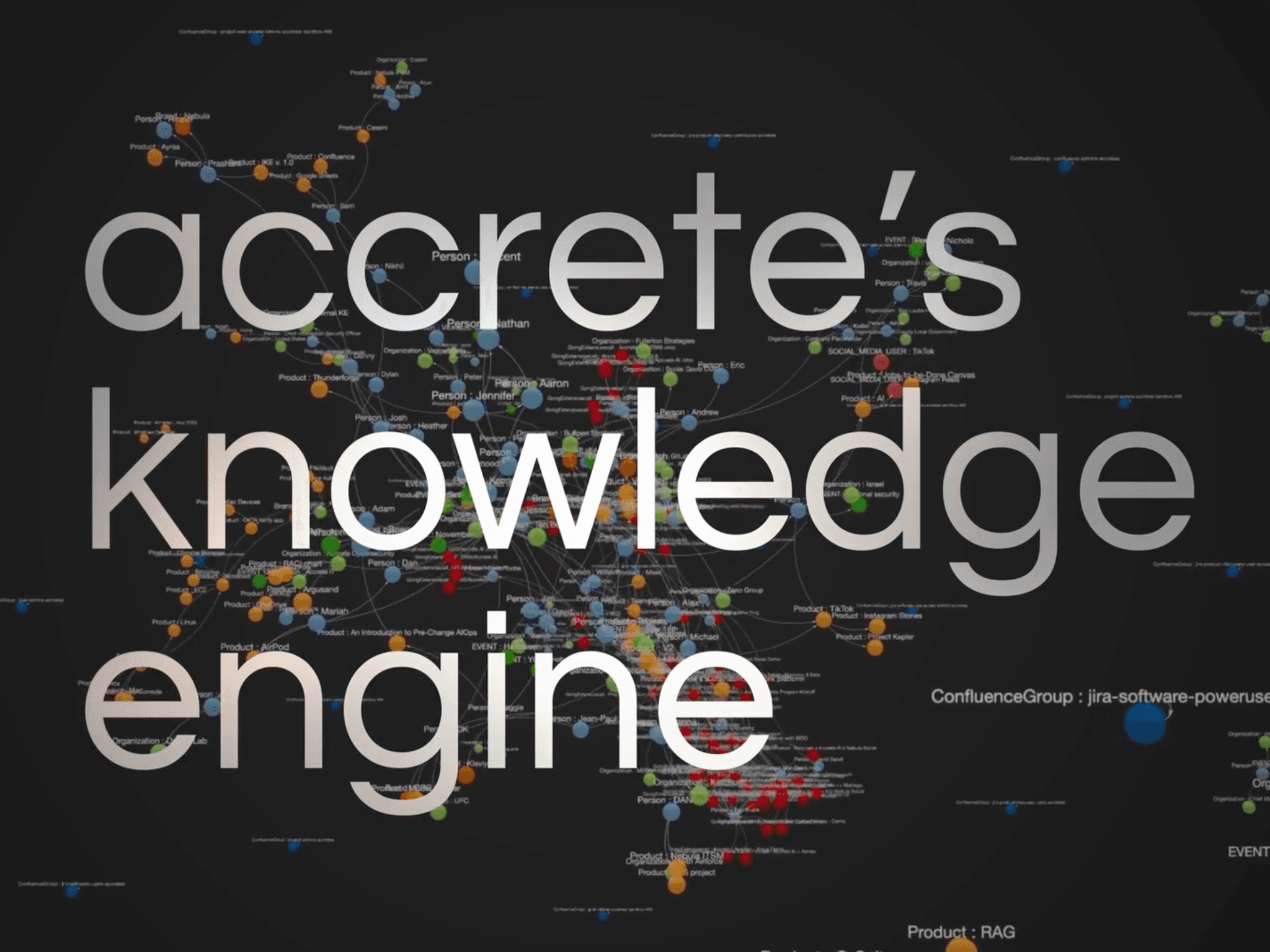
This blog post was created through human collaboration with Accrete's Knowledge Engine.
Summary
Accrete needed to create investor-facing content that clearly differentiated its Knowledge Engine platform from retrieval-based AI systems. The content required alignment across senior stakeholders spanning vision, technical accuracy, and market positioning.
Historically, this type of content took 7–10 days to finalize, driven by fragmented feedback loops, subjective revisions, and repeated alignment cycles. By using its own Knowledge Engine internally, Accrete reduced the end-to-end revision process to approximately 2 hours, while simultaneously improving narrative coherence, technical fidelity, and strategic clarity.
This case study documents how Accrete’s Knowledge Engine transformed strategic content development into an autonomous, auditable process, demonstrating the same capabilities the company delivers to customers.
The Challenge: Strategic Content as a Multi-Dimensional Alignment Problem
Investor-facing content sits at a uniquely difficult intersection:
- Strategic vision, long-term autonomy and paradigm shifts
- Technical truth, what the system actually does
- Market framing, comparisons, differentiation, and ROI
- Human judgment, what to emphasize, omit, or reframe
At Accrete, this manifested as:
- Fragmented feedback from senior stakeholders across different time zones
- Competing priorities between visionary positioning and concrete investor metrics
- Loss of context as drafts circulated through email and meetings
- Reactive editing cycles rather than proactive narrative development
The Traditional Content Development Process (Pre-Knowledge Engine)
Before using the Knowledge Engine, Accrete’s strategic content development followed a familiar but inefficient pattern:
- Initial draft creation typically required 8–12 hours
- Stakeholder review occurred asynchronously via email and meetings over 2–3 days
- Conflicting feedback was manually reconciled over 4–6 additional hours
- A second round of reviews added another 2–3 days
- Final revisions and alignment required 2–4 more hours
Total elapsed time: 7–10 days from first draft to final approval. The core bottleneck was not writing speed. It was alignment under ambiguity.
The Knowledge Engine Approach: Persistent Memory and Collaborative Intelligence
Rather than treating the investor script as a creative exercise, Accrete treated it as a reasoning problem and delegated synthesis to the Knowledge Engine.
1. Context Absorption (Persistent Memory)
The Knowledge Engine ingested a complete and persistent context set, including:
- The original investor video script with embedded feedback
- Email threads capturing stakeholder commentary and rationale
- Strategic messaging frameworks from prior communications
- Technical documentation detailing Knowledge Engine capabilities
- Competitive positioning materials
This context persisted across interactions, eliminating the loss of institutional memory that typically occurs between revision cycles.
2. Multi-Perspective Analysis (Judgment Modeling)
The Knowledge Engine analyzed feedback across three distinct stakeholder perspectives:
- Vision leadership, focused on autonomy, paradigm shifts, and long-term differentiation
- Investor advisory, emphasizing market comparison, defensibility, and retention metrics
- Content strategy, centered on structure, pacing, clarity, and narrative flow
Rather than flattening these perspectives, the Knowledge Engine reasoned across them and treated disagreement as a signal rather than noise.
3. Intelligent Synthesis (Unified Ground Truth)
Instead of merging edits or averaging opinions, the Knowledge Engine performed higher-order synthesis:
- Identified direct conflicts between stakeholder priorities
- Resolved them by anchoring decisions to Accrete’s strategic ground truth
- Connected abstract vision statements to concrete script sections
- Introduced new content to address gaps not explicitly identified by stakeholders
This step transformed subjective input into a single, coherent narrative grounded in institutional truth rather than compromise.
4. Transparent Redlining (Explainability and Trust)
The Knowledge Engine delivered revisions with full transparency:
- [NEW] tags for entirely new sections
- [EDIT] markers for modified language
- [CONDENSED] labels for streamlined passages
- Explanatory notes linking each change to underlying feedback or reasoning
This eliminated ego-driven debate by making editorial decisions auditable and explainable.
Results: Measurable, Not Abstract
Time and Process Impact
- 7–10 days reduced to approximately 2 hours for comprehensive revision
- 95% reduction in stakeholder review cycles
- Immediate availability of a final document instead of days of email chains
Quality Improvements
- 100% of stakeholder feedback incorporated with zero conflicts
- Strategic enhancements identified beyond original feedback
- A coherent narrative preserved despite multiple viewpoints
- Clear, traceable rationale for every editorial decision
Strategic Advantages
- Faster time-to-market for investor communications
- Dramatically reduced stakeholder fatigue
- A repeatable and scalable content workflow
- A live demonstration of Knowledge Engine capabilities in practice
Why Retrieval-Based Systems Fail at This Task
Retrieval-based and RAG-style systems fall short because they:
- Do not retain persistent memory across feedback cycles
- Require users to know what questions to ask in advance
- Cannot synthesize conflicting human priorities
- Do not learn from prior revisions or outcomes
By contrast, Accrete’s Knowledge Engine:
- Maintains persistent context across documents and interactions
- Performs global reasoning that connects vision to execution
- Proactively identifies gaps and contradictions
- Improves with every collaboration cycle
Conclusion
This is not a case study about a video or a marketing artifact. It is proof that Accrete’s Knowledge Engine can autonomously synthesize human judgment into a unified ground truth, even in domains dominated by opinion, bias, and ambiguity.
The investor video script was simply the proving ground. The real outcome was a measurable demonstration that autonomous intelligence is already operational inside Accrete.