Insights
The Real Threat Isn’t Deepfakes. It’s Their Impact.
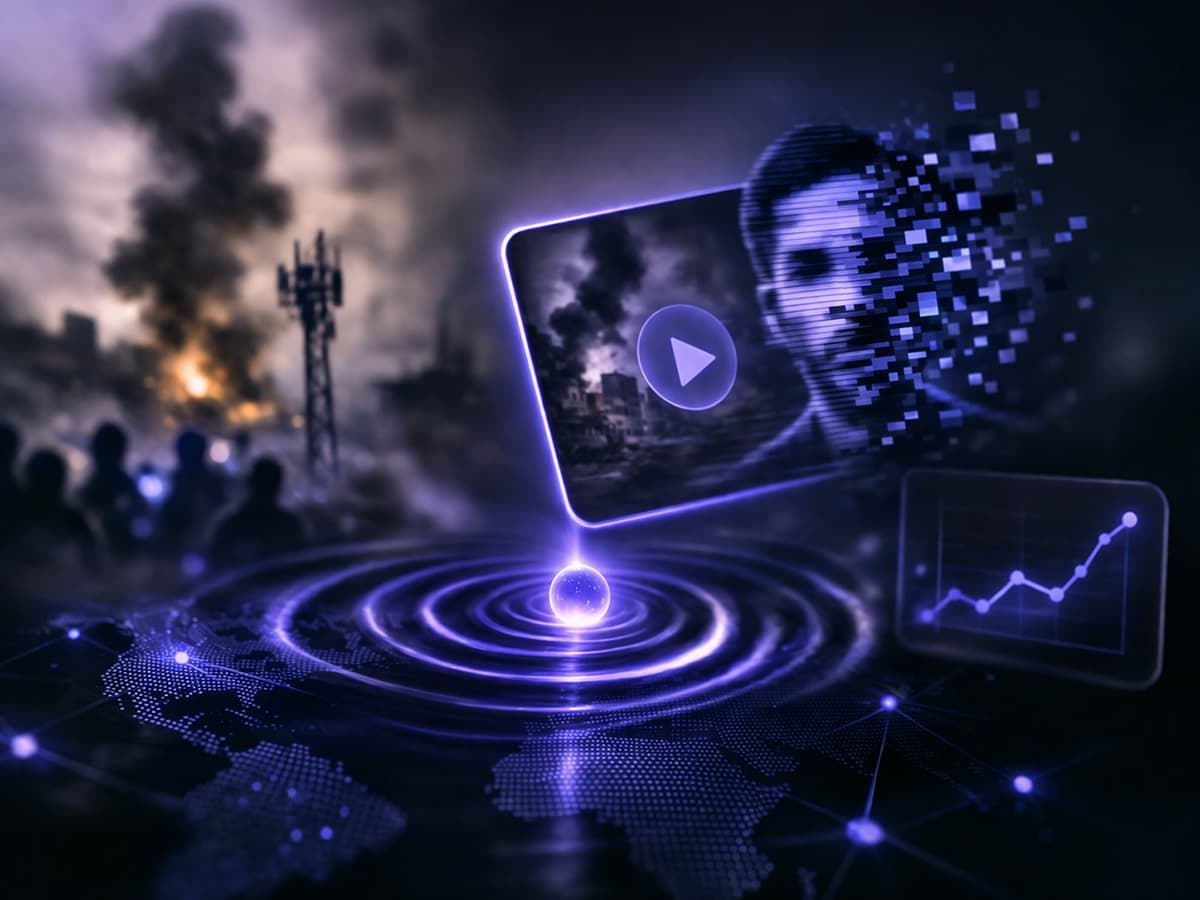
Deepfakes aren’t the real danger - their impact is. In moments of uncertainty, manipulated media shapes perception before truth can catch up.
The Real Threat Isn’t Deepfakes. It’s Their Impact.
In the middle of a crisis, truth rarely disappears all at once.
It fades.
First, the footage stops coming. The phones go dark. The street-level perspective vanishes. Then the uncertainty moves in. Rumors spread faster than confirmation. People begin asking the same urgent questions at once: What happened? Who was hit? Who is alive? Is this real?
And into that vacuum comes the clip.
It might be a missile strike. It might be a speech. It might be hospital footage, a leader’s image, or a dramatic scene ripped from a game and reframed as war. By the time anyone can verify it, millions have already seen it, reacted to it, and absorbed its emotional payload.
That is the world we are in now.
The old question was whether a piece of media was fake. The new question—the one that matters more—is what that media makes people feel, believe, and do before the truth has a chance to catch up.
That is why the real threat is not deepfakes themselves.
It is their impact.
The Iran information environment offers a clear view of how this works.
In recent Argus analysis of the Iran-Israel conflict, one of the largest narrative clusters reached 178,132,045 views across 81 posts across Telegram, X, YouTube, TikTok, and Instagram. It was not just large. It was revealing. The cluster explicitly noted that AI-generated and repurposed videos were spreading misinformation at the same time a near-total internet blackout restricted ground footage.
That is the story in one scene.
When real visibility collapses, fake visibility rushes in.
When people cannot see reality clearly, they become vulnerable to whatever looks enough like reality to fill the gap.
This is why deepfakes are so dangerous in moments of conflict. Not because they are technically sophisticated. Not even because they are always convincing. They are dangerous because they arrive at the exact moment when people are desperate for proof and least able to verify it.
Argus’s Iran reporting makes that pattern hard to ignore. It shows an information environment where synthetic and manipulated media do not simply circulate randomly. They cluster around moments of maximum emotional vulnerability: blackouts, strikes, leadership uncertainty, conflicting reports, and viral cross-platform attention.
You can see it again in another Iran-related narrative Argus surfaced: conflicting reports surrounding Mojtaba Khamenei after strikes. That cluster generated 25,975,336 views across 40 posts and was defined by exactly the kind of ambiguity that makes manipulated media powerful—official denials, contradictory claims, and an internet blackout that hindered independent verification.
This is how the mechanism works.
When people hear that a senior figure may be dead, wounded, or missing, they do not wait patiently for a validated report. They look for evidence. They want a photo, a clip, a statement, anything that feels like confirmation. And that demand for confirmation creates the perfect opening for deception. A fabricated hospital video. An altered image. A synthetic statement. A clip that is false but emotionally timed so well that it feels true enough.
That is why the most dangerous deepfakes are often not the most technically impressive ones.
They are the ones that appear at the perfect narrative moment.
The Iran materials also show that manipulated content does not spread alone. It travels with packaging.
One cluster, “Iran Portrayed Militarized Amid Regional Tensions,” drew 83,915,003 views across 88 posts and emphasized that satire and memes dominated commentary on Iran geopolitics.
That matters because misinformation rarely presents itself as misinformation. It arrives as entertainment. As mockery. As commentary. As something “everyone is sharing.” The meme makes the manipulated clip feel lighter, funnier, easier to pass along. The joke lowers the audience’s guard. The repost gives the narrative a second life. The screenshot gives it a third.
By then, the question of authenticity is already losing ground to the reality of engagement.
And that is the deeper shift.
Deepfakes do not win because they are perfect forgeries. They win because they fit the emotional logic of the moment.
The same pattern appears in how people respond to debunks.
One of the most striking findings in the Iran narrative materials is that even when fact-checking content performs well, the response often shifts almost immediately into a fight over trust. In comment sections tied to debunking posts about fake or repurposed conflict footage, people were often less interested in whether the clip was false than in whether the debunker could be believed at all.
That is a profound change.
It means the information battle is no longer just about authenticity. It is about legitimacy. It is about who gets to define reality in a distrust-saturated environment.
In other words, the correction itself becomes part of the conflict.
That is why this is bigger than a content problem. It is a perception problem.
The good news is that the Iran case also shows that reality still leaves traces.
Even in polluted information environments, truth does not vanish completely. It fragments. It emerges in pieces. It appears in harder-to-fake evidence streams that begin to stabilize the picture. In the Argus materials, one cluster focused on satellite imagery revealing damage to Iran’s military sites, drawing 55,662,833 views across 37 posts.
These details matter because they point to something essential: in the fog of AI-enabled disinformation, truth still has structure.
Satellite imagery. Geospatial analysis. Official rebuttals. Verification graphics. Corroborated evidence chains. These do not always travel as fast as the fake. But they provide something synthetic media cannot: a path back to shared reality.
This is where Argus for Cognitive Advantage becomes so important.
Its value is not simply that it helps analysts spot suspicious content. Its value is that it helps them see the environment in which suspicious content becomes effective. It reveals where narrative velocity is accelerating, where verification is impaired, where audiences are most likely to accept synthetic proof, and where credible counter-signals are beginning to form.
That is the difference between reacting to a fake and understanding why the fake matters.
And in today’s information battles, that difference is everything.
Because the real problem is not that a false video exists somewhere online.
The real problem is that it lands at the precise moment a population is confused, emotionally charged, and searching for certainty.
By the time the content is disproven, it may already have done what it came to do.
It may have hardened a narrative. It may have amplified fear. It may have discredited authentic reporting. It may have made people doubt the next real piece of evidence they see.
That is impact.
And that is why the central question in the deepfake era can no longer be limited to Is this fake?
The better question is: What is this doing to the audience before the truth arrives?
Because deepfakes themselves are not the whole story.
Their impact is.