Insights
Navigating the Fog of Reality
As Iran’s 2026 uprisings unfold, the fight isn’t just in the streets - it’s in the feed. Accrete’s Argus maps how distrust, neutrality, and competing narratives shape perception, helping analysts track how reality is constructed, contested, and weaponized in real time.
How Argus Maps Narrative Power in the 2026 Iran Uprisings
The first casualty in Iran’s 2026 uprisings wasn’t the truth. It was trust.
A clip hits social media: shaky footage, shouting, a surge of bodies, then the camera drops. Within minutes it’s everywhere—stitched into montages, slowed down, zoomed in, circled, captioned, translated, reposted. The comments arrive even faster than the context. Massacre. Old footage. Staged. False flag. Proof. Psyop.
Almost immediately, the argument stops being about what happened. It becomes about who wants you to believe it happened.
That’s the defining reality of modern conflict, and it is especially visible in Iran’s 2026 uprisings: the struggle isn’t only fought in the streets. It’s fought in timelines, comment threads, and private channels where millions of people are trying to answer a question that used to feel simpler: What’s real—and who gets to define it?
When a country stops believing its institutions
For decades, many Iranians have seen IRIB as propaganda—sometimes even featuring forced confessions—so distrust hardened into a reflex: assume manipulation first. There’s a formal phrase for this mindset—“hermeneutics of suspicion.” In plain terms, it means people interpret messages as if deception is built in.
They don’t ask, “Is this true?”
They ask, “What’s the angle?
And it no longer targets only state media—it spills onto foreign outlets, activists, influencers, and witnesses. The result is a fog of reality, where trust is so broken that even accurate information struggles to stick.
The analyst’s problem: the story beneath the story
If you’re monitoring Iran, whether as a journalist, NGO, policy team, or risk analyst, you quickly realize the problem isn’t scarcity of information. It’s overflow.
There is too much content, arriving too fast, mixed with counterclaims, edits, debunks, re-debunks, satire, and deliberate deception. Meanwhile, the audience is trained by experience to treat every source as potentially compromised. In this setting, “verification” isn’t just a process. It’s the battlefield itself.
So the task changes. The job is not only tracking events. It is tracking how reality is being constructed—post by post, narrative by narrative, community by community.
That’s where Accrete’s Argus becomes valuable. Instead of only counting mentions or trending hashtags, Argus functions like a narrative map. It helps teams identify:
- which storylines dominate attention,
- how those storylines evolve over time,
- and how audiences position themselves—supportive, opposed, or uncertain.
Because in a fog of reality, uncertainty isn’t a side effect. It’s a weapon, a shield, and sometimes a trap.
The first signal: distrust as the dominant storyline
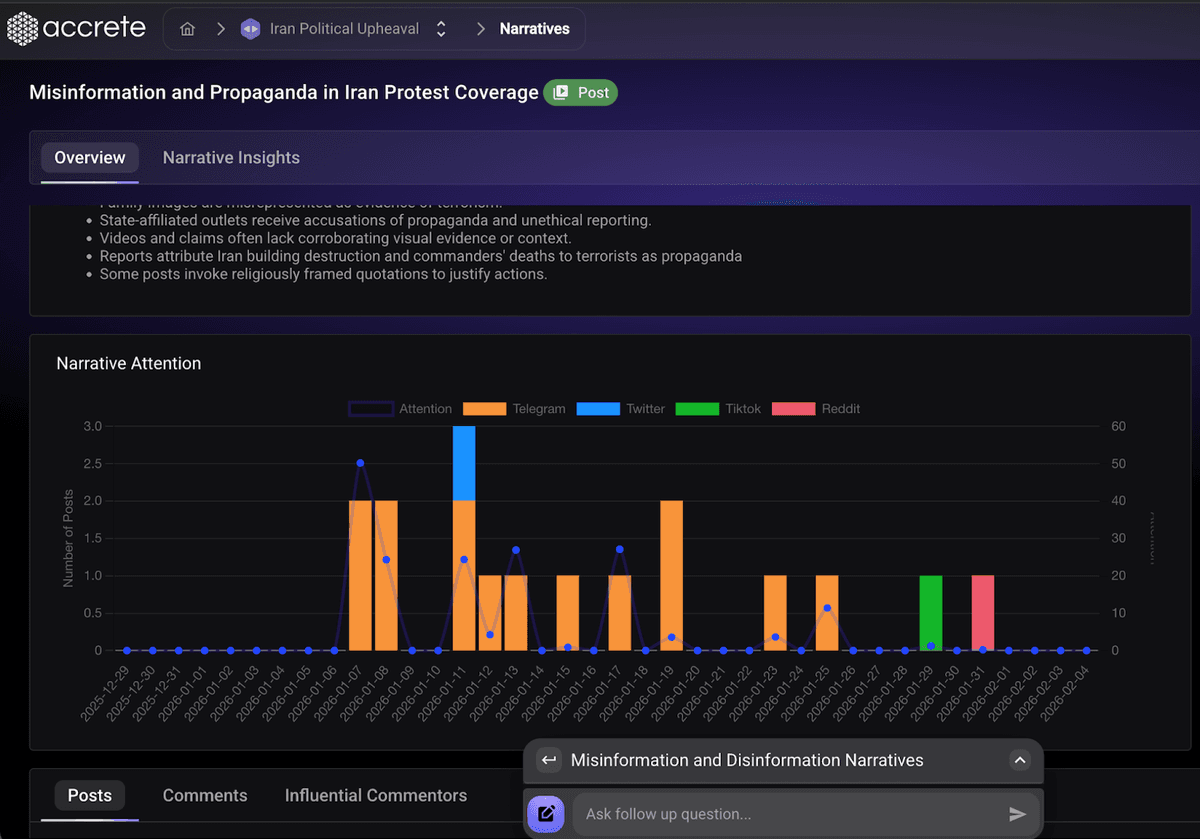
When Argus analyzed thousands of posts and comments during the unrest, a single narrative rose above the rest:
“Misinformation and Propaganda in Iran Protest Coverage.”
In the dataset, about 66% of top comment threads led with media distrust—not quibbling over details, but rejecting all major sources as unreliable. This “media orphan” mindset leaves people isolated, filtering every claim through one question: Who benefits if I believe this? That skepticism set the stage for an early-February example showing how doubt shapes reactions even when evidence looks clear.
The memo: when “neutral” is the loudest reaction
A post captured in Argus referenced what was described as a leaked Tasnim News Agency memo dated February 2, 2026. The memo outlined a strategic media plan attributed to networks aligned with the Islamic Revolutionary Guard Corps (IRGC), aimed at undermining the influence of exiled Prince Reza Pahlavi.
In a higher-trust environment, reactions might split neatly into belief and disbelief. But Argus stance analysis surfaced something more revealing: 52% neutrality.
Neutrality here doesn’t mean indifference. In a suspicion-saturated information space, neutrality often means:
- I’m not sure what’s true, but I’m sure someone is manipulating this.
- I won’t commit to believing it, and I won’t commit to rejecting it.
- Prove your source deserves trust.
In other words, neutrality becomes self-defense. But it can also become paralysis—because when the safest position is perpetual doubt, collective judgment slows down, and coordinated action becomes harder.
The blackout: when evidence breaks through the silence
Then came the silence.
On Jan 8, 2026, Iran imposed a near-total internet shutdown, creating an information vacuum. Argus then shows a surge around Jan 11 as footage tied to the “January Massacres” spread beyond Iran. As graphic videos circulated, state media tried to “flood the zone” with stability imagery and pro-regime rallies—overwhelming the feed so no single reality could take hold.
In the comment threads, people didn’t simply watch. They cross-examined:
- Who posted this first?
- Where is it from?
- Why now?
- What do they gain if I believe it?
The footage wasn’t just evidence. It became a test—of credibility, identity, and allegiance.
The “both sides” trap: how outrage gets diluted
Distrust doesn’t stop at the regime. It spreads outward, then sideways.
Argus data showed a significant pattern described as narrative contamination through global grievance framing—about 33% in the statistic cited. A notable share of commenters redirected discussion away from Iran entirely, folding it into broader claims about Western hypocrisy, selective outrage, elite cover-ups, or unrelated scandals.
The move is subtle but powerful: if outrage is selective, then outrage is illegitimate. If everyone is lying, then no one deserves belief.
Activists often call this the “both sides” trap—not because critiques of Western media are always wrong, but because the pattern can function as derailment. It blurs responsibility, dissolves urgency, and turns a specific crisis into a generic argument about “the media.”
Two competing definitions of truth
Inside the fog, people lean on two main ways to “prove” what’s real:
1) Lived experience: With institutions distrusted, the eyewitness becomes the authority—firsthand accounts, prison stories, family updates, diaspora testimony. “I was there. I know what I saw.”
2) Data as refusal: Technical disputes—especially about death counts, sourcing, and verification—are used to cast doubt on reports of violence. Some critiques are valid, but they can also function as a way to avoid accountability.
Conclusion: clarity when trust is gone
The fog of reality sets in when suspicion becomes the default and disbelief is rewarded. Then the key question shifts from “What happened?” to “Which storyline is winning—and why?”
Argus helps by mapping narrative attention and stance shifts, showing how distrust spreads—so organizations can find signal in the noise and act responsibly in a contested reality.