Insights
The Screen That Said the Border Was Open
A viral "border open" narrative drove a real migration surge at Ceuta in 2026. Here's how Argus tracked the feedback loops across TikTok, X, and Reddit — and turned that signal into a rapid-response playbook.
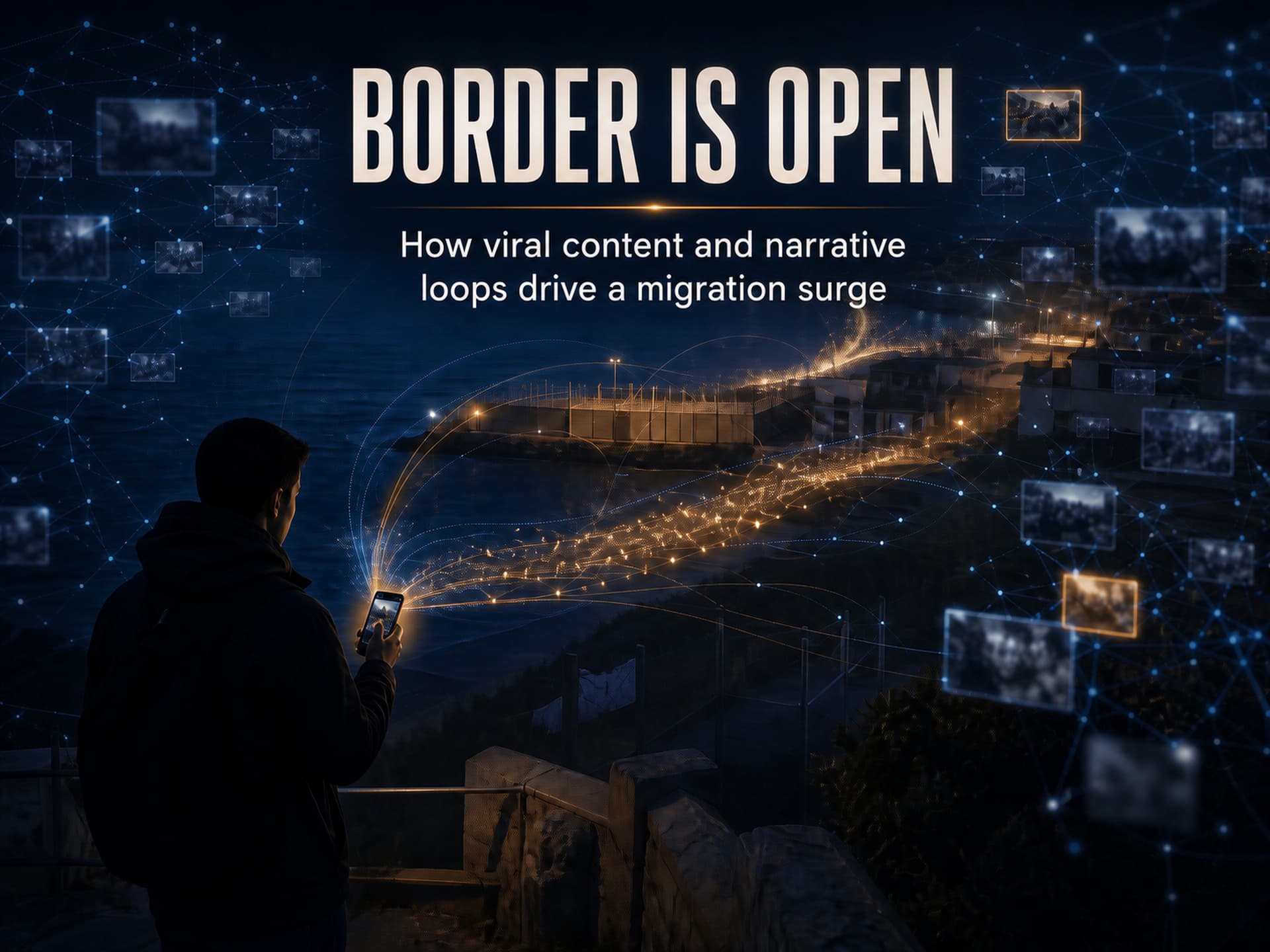
Argus for Cognitive Advantage shows how a story scales and suggestions for response.
A phone, a video, a message from a friend
In the streets around Ceuta's migrant reception center, a Spanish reporter kept hearing the same story, told over and over by people with nothing else in common.
Moroccans. Afghans. Nigerians. Sudanese. Different countries, different routes, different reasons for leaving. But asked about the moment they decided to move, they described the same thing: a phone, a video, a message from a friend. A screen that told them the border was open.
El Confidencial published that reporting on TikTok on August 2, 2026, drawing 125,900 views and 2,300 likes. By then, Ceuta had absorbed one of its largest migration surges, Spanish military units were reinforcing the frontier, and the death toll had passed seventy.
The slow burn nobody clips
Every crisis has a boring phase, and that's where the signal lives — also where most monitoring tools stop looking, since nothing looks like a headline. By early July 2026, Argus for Cognitive Advantage was tracking a narrative cluster around migration pressure at the Ceuta border — not because anyone flagged it, but because the platform ingests and clusters conversation across TikTok, Twitter/X, and Reddit before any post is newsworthy. The framing was familiar: enforcement strain, humanitarian distress, local tension. Windows opened July 5, looking like background noise.
Between July 30 and August 3, that space stopped being background noise. Argus's analysis mapped 1,831 posts, 26,441 comments, 29 distinct narratives, 99 comment conversations, and 47 sources — a multi-source ecosystem, not one outlet with an echo. Platform mix: TikTok 51.03%, Twitter 46.91%, Reddit 2.06% — a slow-burn issue becoming fast-moving, visible only because Argus had watched since the boring phase. The conversion came when an opportunity rumor took hold.
The feedback loop
Here is the mechanic Argus for Cognitive Advantage surfaced: viral "proof of access" content amplified a perception that Ceuta — and Spain, and the EU — was temporarily easy to enter, plausibly increasing attempt volume. More attempts produced more footage, more footage produced more proof, and the loop fed itself. Argus's narrative-mapping isolated each stage with a specific post as evidence:
Proof. A TikTok explainer on August 1 described the Ceuta situation at 7:00 PM — some migrants returning to Morocco, others still trying — laying out the route: cross the land border, or swim around the coastal barriers, framing Ceuta as EU territory. 310,900 views, 7,300 likes. Not emotive — a mental model of what allegedly worked.
Scale. A meme-format map video on July 31 claimed roughly 49,000 crossings from Morocco into Ceuta in 24 hours, delivered with a laughing emoji. 56,100 views. Large numbers plus movement visuals shift the message from some people attempt this to mass participation is happening now — what imitation dynamics run on.
Permission. On August 1, a slide-format post claimed a Spanish Supreme Court judgment from July 8 barred Spain from summarily returning people intercepted while swimming, since that route crosses no physical barrier. Its caption named the consequence: traffickers read it as an open door — the clearest case for why tracking must run continuously, since nobody had to prove the claim.
Routine. Faro TV posted footage on August 2 of two migrants sprinting inland after reaching shore at La Ribera, noting constant arrivals kept tension high. 60,800 views. Repeated arrival footage normalizes: entry attempts read as ongoing and routine rather than dangerous.
Redistribution. On July 30, a Twitter account posted a video of people clinging to a car heading toward Ceuta — 548,200 views, the highest reach in the Twitter layer. TikTok supplied the imitable visuals; Twitter globalized them within hours.
The enforcement paradox
Then came a finding a keyword dashboard would never produce: insight that surfaces only when a platform scores engagement against narrative function, not mentions. Argus uncovered it.
Response content — the state acting decisively — was the highest-engagement material in the dataset. Europa Press's TikTok on August 1, reporting the irregular flow had ceased and National Police and the Army had relocated those remaining in the border zone, drew 2.7 million views and 91,100 engagements. El Confidencial's post on the Tarajal breakwater barrier — 500 meters long, 30 to 70 centimeters above the surface, submerged up to a meter — drew 1.2 million views and 24,400 combined comments and likes.
Argus read that as more than interest in government competence: audiences were tracking whether the window was closing. Enforcement content kept the maritime route salient by specifying where and how crossings happened. A second loop compounded it: international outlets packaged fatalities, military reinforcement, and an upcoming EU meeting for audiences outside Iberia, intensifying advocacy and backlash messaging and raising volume again.
Coordinated, or just crowded?
The question every information operations analyst eventually asks: is somebody running this? Most monitoring tools answer this question inadequately, because "coordinated" and "viral" produce the same chart if you're only counting volume. Argus's answer: the evidence supported format-level coordination, not actor-level coordination.
The fingerprints were everywhere: standardized crisis hashtags, recycled frames ("border open," "open door," "tens of thousands"), and similar explainers in rapid succession — what decentralized actors optimizing for the same algorithms look like. The absences were equally telling: no hub-and-spoke command structure, no origin account with visible repost chains, no organizer channels setting posting times.
Argus's actor-layer mapping explained why: a mixture, not a machine. Institutional media with reach — news.com.au at 1,592,973 followers, Europa Press at 701,200, El Confidencial at 471,500 — local coverage like Faro Ceuta at 84,000, independent creators like a "I went there myself" travel vlog drawing 392,500 views and 1,085 comments, and political commentators repurposing the footage into demands, including calls for the EU to halt payments, investment, and tourism to Morocco.
Different actor types reusing identical evidence to advance incompatible agendas mean high decentralized amplification, moderate coordination risk — conflating the two is how organizations waste the hours that count.
Argus also flagged what the data couldn't support: no clean posting histogram for the keyword set, so volume deltas couldn't be quantified, and Instagram was absent from post-level evidence despite captions referencing cross-platform spread — a deliberate choice, since Argus flags its own confidence limits rather than let a chart imply certainty it doesn't have.
From insight to action: the playbook Argus built
Finding the mechanism is only half of what a cognitive advantage platform owes an organization living through it — the other half is telling them what to do, in a form operations teams can act on immediately. Argus for Cognitive Advantage generated a campaign playbook from the same tracked network — 1,831 posts and 26,441 comments, narrowed to a 146-post TikTok/Twitter core spanning July 8 to August 3 — broken into three phases:
Campaign phases
Pre-acceleration attention (Jul 5 – Jul 12). What changed in the narrative: ongoing pressure, protests, humanitarian strain — not yet open-entry claims. Operational implication: build baseline myth tracking; seed risk and legal content early.
Acceleration trigger window (Jul 30 – Aug 3). What changed in the narrative: convergence on mass crossings, enforcement stress, feasibility and policy rumors. Operational implication: shift to rapid rebuttal and harm-reduction messaging within hours.
Aftermath and politicization (Aug 2 – Aug 3). What changed in the narrative: saturation at Migrant, returns, policing, polarized interpretations (invasion vs. solidarity vs. state failure). Operational implication: de-escalate polarization while sustaining deterrence and legal clarity.
Playbook components
That phasing came from the same narrative-clustering timeline Argus had run since early July, turned into named playbook components with a monitoring target and countermove:
Trigger detection. What to monitor: posts claiming the border is open, wide open, easy entry; crowds swimming or moving en masse. Why it matters: reduces uncertainty, drives imitation. Fast counter-move: respond within hours with myth-vs-reality and legal content.
Feasibility disruption. What to monitor: proof-of-entry clips and aftermath scenes implying crossings continue. Why it matters: creates social proof, compresses decision cycles. Fast counter-move: pair visuals with consequences, returns, limits on onward travel.
Attribution warfare. What to monitor: claims of state failure, deliberate leverage, or conspiracy framing. Why it matters: hardens polarization, reduces trust in official updates. Fast counter-move: use credible third-party explainers; avoid inflammatory labels.
Humanitarian saturation content. What to monitor: Migrant overload, minors, shore-arrival imagery. Why it matters: generates empathy but can also signal opportunity. Fast counter-move: emphasize safety guidance; clarify aid isn't permission.
Cross-platform amplification. What to monitor: TikTok virality tags and reuploads; Twitter/X quote-post politicization. Why it matters: decentralized but patterned replication. Fast counter-move: use TikTok-first rebuttals and X threads linking to the same clip.
Argus also named the accounts shaping the story: @elespanolcom and @elconfidencial for high-reach crisis framing, @news.com.au for the rumor-to-surge clip, @faroceuta for arrival visuals sustaining "it's still happening," @Newsforce for skepticism toward returns claims, @AdaLluch for the politicized rations post — each with its evidence link, so a team could go straight from playbook to post.
Its conclusion: a TikTok-first rapid response disrupting feasibility rumors within hours using multilingual myth-vs-reality video, deterring crossings by reducing certainty and clarifying legal outcomes while de-escalating politicized interpretations through non-inflammatory language. Full prevention isn't realistic once proof-of-entry visuals spread; scale reduction is, if the response moves early.
What cognitive advantage actually means
The strongest throughline: social media didn't just report the crisis, it helped shape behavior — by making entry appear feasible, imminent, and widely attempted. So the intervention point isn't the surge, it's the rumor, in the first 24 hours, before proof-of-access content compounds.
That's the gap Argus for Cognitive Advantage closes: not a report after the fact, but a system that compresses the distance between a narrative forming and an organization understanding it well enough to act, then hands them a plan, not just a finding. That meant identifying the causal claim ("the border is open"), the accelerant surface (TikTok), the translation layer (Twitter), the actors carrying the frame, the languages the cascade ran in — Spanish, English, German, Portuguese — and the phase-by-phase response to run, while the event was still live.
Seventy people died making a crossing that a screen had told them was easy. Perceived feasibility moved faster than formal policy, and viral proof substituted for official information. Argus for Cognitive Advantage catches that substitution while it's happening, turning it into a plan fast enough for the response to travel as fast as the rumor did.
This analysis drew on 283 posts from TikTok, Twitter, and Reddit between July 30 and August 3, 2026, within a broader tracked network of 1,831 posts and 26,441 comments. The playbook drew on a 146-post TikTok/Twitter dataset spanning July 8 to August 3, 2026. Argus for Cognitive Advantage runs on Accrete's Knowledge Engine platform.